Protecting Your Work and the Connections That Matter — Part 3
What if you could not do your usual work one morning?
Imagine opening your shop one morning.
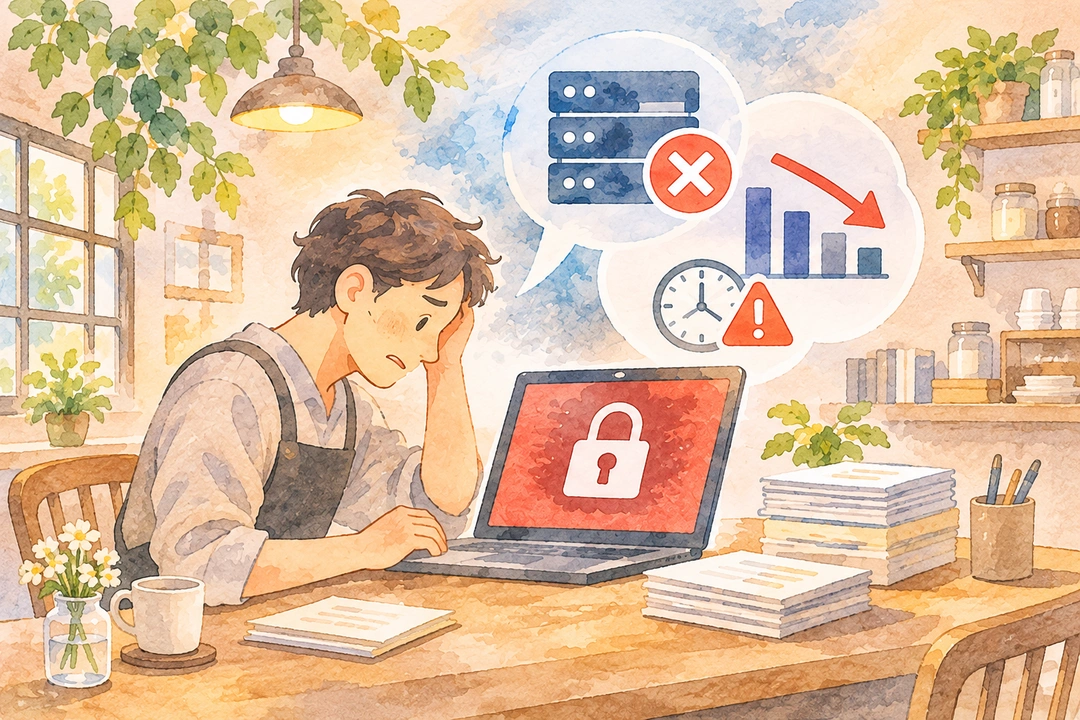
You try to check the reservations, but you cannot log in to the booking service. Restarting your computer does not help. Trying from your smartphone makes no difference either.
You cannot reply to customer inquiries, and you do not even know how many reservations you have for the day. Everything worked normally yesterday, but now you cannot move forward with your work.
“Has our customers’ information been stolen?”
Of course, that would be worrying.
But in this situation, what causes the immediate problem is something else: you do not know how you are going to keep the business running today.
You cannot check reservations. You cannot contact customers. You cannot provide your service as planned.
Even if no information has been exposed, losing access to something your work depends on can be a serious problem.

A cyberattack can cause more than one kind of damage
When people hear the term “cyberattack,” they may imagine customer information or credit card details being stolen.
Information being exposed is certainly serious. It can cause problems for customers and business partners, require explanations and follow-up, and damage trust in the business.
But that is not the only possible impact.
For example:
| What happens | How it affects the business |
|---|---|
| Information is exposed | You may need to explain what happened and respond to customers and business partners |
| Data is changed | You may no longer be able to trust amounts, order details, contact information, or other records |
| Data is deleted or becomes inaccessible | You may be unable to check reservations, accounts, customer information, and other records |
| Systems or services become unavailable | Everyday work such as taking orders, accepting payments, and communicating may stop |
In other words, a cyberattack can make information unreliable or unusable, or prevent the systems you need for work from operating at all. It is not only about information being stolen.
Having data is not enough if you cannot use it
Let’s make this more concrete.
Suppose you manage customer and reservation information on a computer.
If the data disappears, you may no longer know who is scheduled to visit or when. If the data is changed, you may not be able to tell which contact details or order information are correct.
And even if the data itself still exists, you cannot use it when you need it if the device or service that stores it is unavailable.
With a paper ledger, you can check whether it is still on the shelf. With data stored on a computer or in a cloud service, it may not be immediately clear whether it is merely hidden from view, damaged, or changed by someone else.
One problem can affect other parts of the business
The place where a system stops working may not be the only place affected.
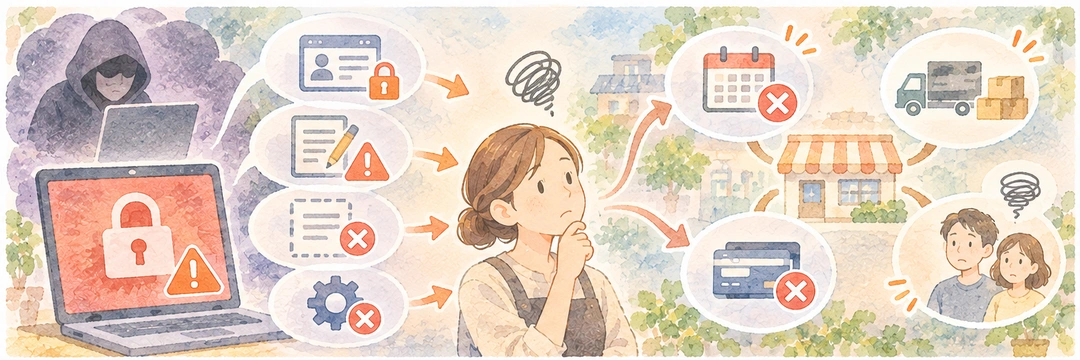
If reservation management stops, communicating with customers becomes difficult. If order information cannot be checked, ordering from suppliers may also be affected. If payments cannot be processed, you may be able to provide a product or service but have trouble collecting payment.
Meanwhile, rent, wages, supplier invoices, and other costs may still need to be paid. Time spent responding to the problem is time taken away from the work you normally do.
The scale of these effects is not determined by the size of the business alone.
A large company may have another department or staff member who can take over some tasks. In a small business or a sole proprietorship, one person may be responsible for several different roles.
As a result, the loss of a single service that you normally rely on can affect the business as a whole.
And when your work stops, customers and business partners may be affected as well. As we saw in Part 2, our work depends on many people and services.
Work continues even after an incident
A cyberattack does not necessarily come to an end as soon as a system is restored.
You may need to find out what happened, explain the situation to customers and business partners, look up information again, and check orders and reservations. Depending on the circumstances, you may also need to consult specialists or contact relevant authorities.
All of this takes time and effort.
And rebuilding trust after it has been lost may take even longer.
That is why cybersecurity is not only about preventing information from being stolen.
It is about protecting important information, protecting the systems your work depends on, and being prepared to keep working even if something goes wrong.
These things are all connected.
What would be difficult to do without in your business?
Take a moment to think about one thing.
What would cause the biggest problem if it became unavailable in your business tomorrow?
- Customer contact details or reservation information
- Order records or sales records
- Payment or banking services
- Communication methods such as email or phone
- Computers or stored business data
You do not need to list everything. Start by choosing just one.
What would you be unable to do if it became unavailable? Is there another way you could do that work?
It is fine if you do not have an immediate answer. Thinking about it is itself a step toward protecting your business.
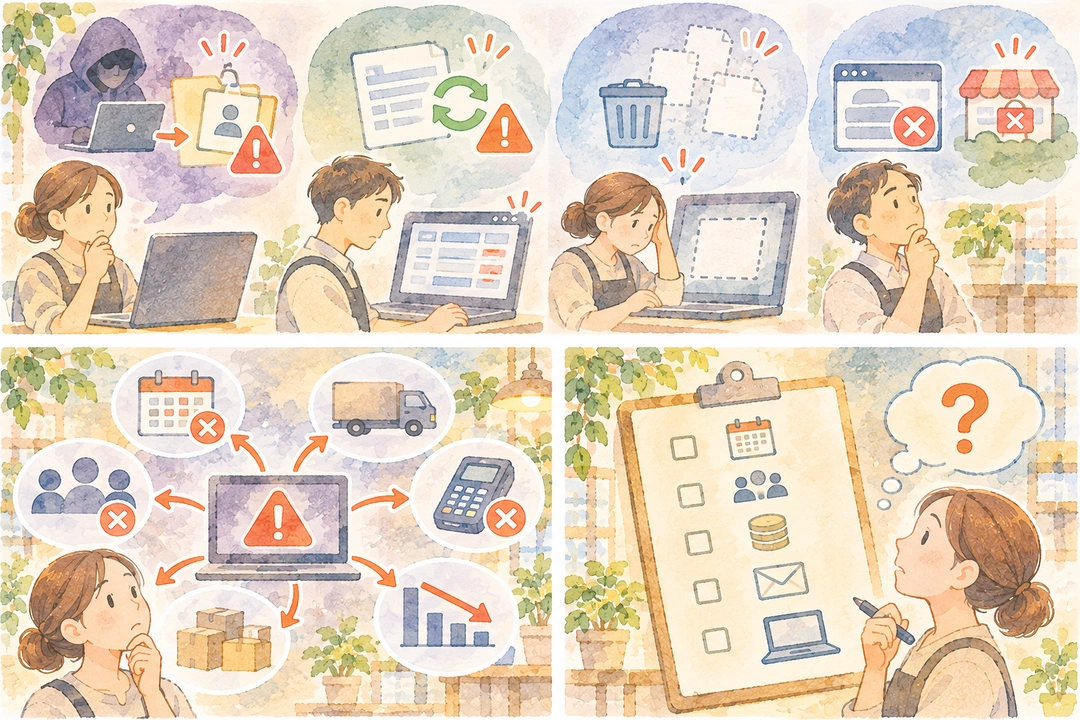
A cyberattack does not only steal information. It can also stop everyday work or make it impossible to carry out correctly.
The point is not to make you afraid. It is to help you recognize what matters to your business.
In the next article, we will look at where these problems can come from. Is it enough to pay attention only to your own computer or shop? Let’s explore the unexpected places that can become points of entry.