Protecting Your Work and the Connections That Matter — Part 2
How a product reaches the customer
Imagine a small bakery.
The owner gets up early, bakes bread, puts it on display, and sells it to customers. They buy ingredients, check the baked goods, serve customers, and keep track of sales.
At first glance, it may look as though the work happens entirely between the owner and the customer.
But let’s pause and think about it.
To bake bread, the owner needs flour and butter. There are suppliers who deliver those ingredients. Electricity is needed to run the oven. The bakery uses a register and a payment service to sell its products. It may also use accounting software to record sales and email to communicate with business partners.
Even when one person runs the whole bakery, the work does not depend on that person alone.

Our work depends on many connections
This is not unique to bakeries.
Here are some examples of the people and services that may support everyday business activities:
| Business activity | People and services involved |
|---|---|
| Getting products or materials | Suppliers, manufacturers, delivery companies |
| Communicating with customers | Phone, email, messaging services |
| Receiving reservations and orders | Booking websites, order-management systems |
| Receiving payments | Banks, card issuers, payment services |
| Handling administration and accounting | Accounting software, cloud services |
| Storing business data | Computers, storage devices, backup services |
The people and services a business needs will vary. No business needs to use all of them.
But many businesses rely on things they could not provide or maintain entirely on their own.
Those people, companies, and services allow us to focus on our own work.
In the previous article, we looked at the connections that are easy to overlook by using customer Wi-Fi as an example. Now let’s take a wider view.
Our work itself depends on a network of people, companies, and services.
What if one of those connections stopped working?
These relationships are very useful in our everyday work.
We can have the things we need delivered. We can communicate with people far away. We can rely on services to handle complicated calculations and records. Things that would be difficult to do alone become possible with help from other people and systems.
But what would happen if one of those services suddenly became unavailable?
For example:
- A supplier’s ordering system stops working, so you cannot order the ingredients you need.
- A payment service has an outage, and you cannot accept card payments.
- You cannot access the cloud service where your accounting data is stored, so you cannot check important records.
- Email stops working, making it difficult to contact customers and business partners.
Wouldn’t each of these situations make it difficult to run your business?
Of course, these problems are not necessarily caused by cyberattacks. They can also result from equipment failures, network outages, or problems with the service provider.
The important point is this: even when nothing has gone wrong at your own business, a problem with something that supports your work can still affect you.
If a supplier or a service you rely on is hit by a cyberattack, the effects may reach your business as well. An ordering or communication service might stop working, or you might no longer be able to check information needed to complete a transaction.
Not every connection will immediately spread a problem to another business. But if you do not know what supports your work, it can be difficult to know what might cause trouble when something goes wrong.
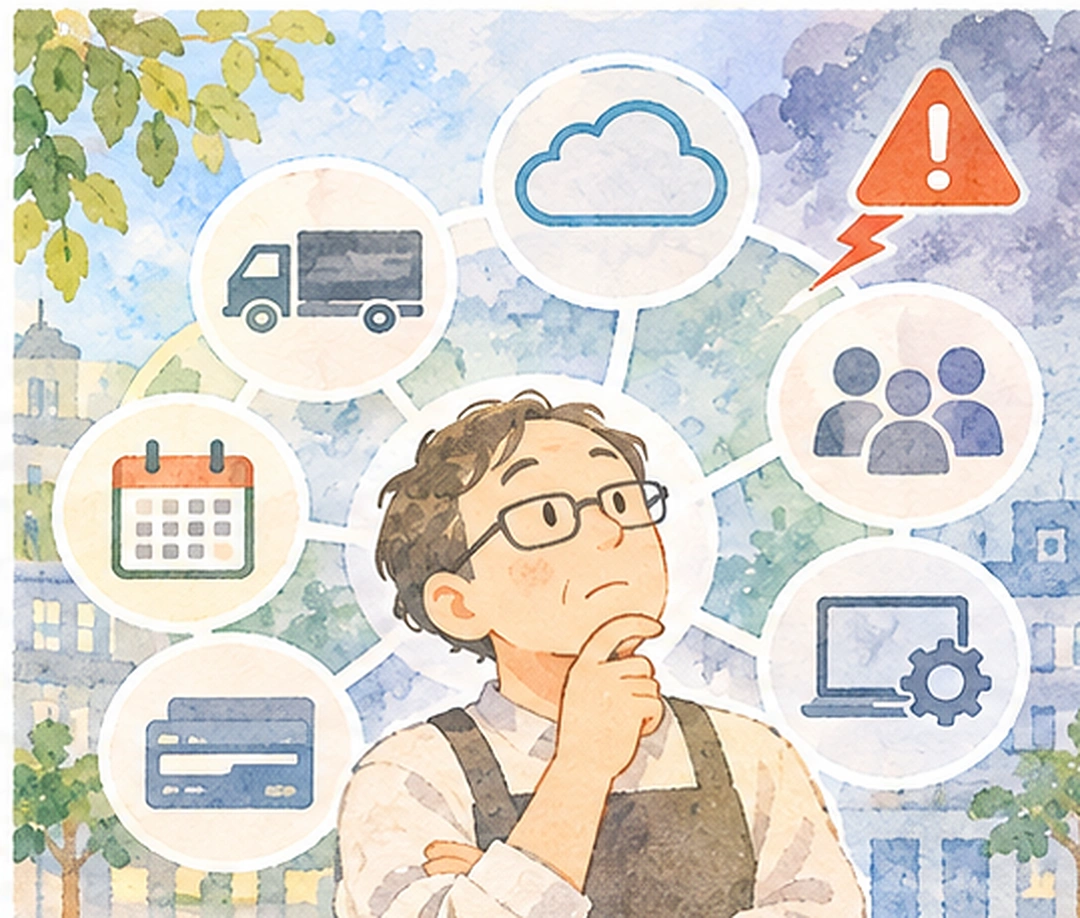
This network of connections is called a “supply chain”
Many people and companies are involved in getting a product or service to a customer.
Some provide materials, others manufacture products, transport them, or sell them. Each plays a part and passes the work on to the next person or organization.
This series of connections is called a supply chain.
The term may sound technical, but the idea is familiar. It simply describes the relationships that support the work we do every day.
And supply chains are not just for large corporations.
A sole proprietor, a small shop, and a company with only a few employees all have their own supply chains.
Being small does not mean that you can do business without depending on anyone else.
Take a moment to think about what supports your work
Let’s take a moment to look at your own business.
From the time you start work until you deliver a product or service to a customer and receive payment, which people, companies, and services are involved?
It may be enough to write down these three things:
- People and businesses your work depends on: suppliers, business partners, outside contractors, and others.
- Services your work depends on: email, payments, reservations, accounting, cloud services, and so on.
- Things that would cause trouble if they became unavailable: data, equipment, communication methods, records, and so on.
You do not need to identify everything at once. Just start with whatever comes to mind.
Writing these things down may reveal connections that you rarely think about.
Protecting your work does not mean protecting only your computer or your shop. It also means taking care of the relationships with the people and services that support your business.
And because those connections exist, a problem somewhere along the way may affect you, too.
In the next article, we will look at what a cyberattack can really mean for a business. Having information stolen is not the only kind of damage. We will consider what happens when you can no longer keep working.